

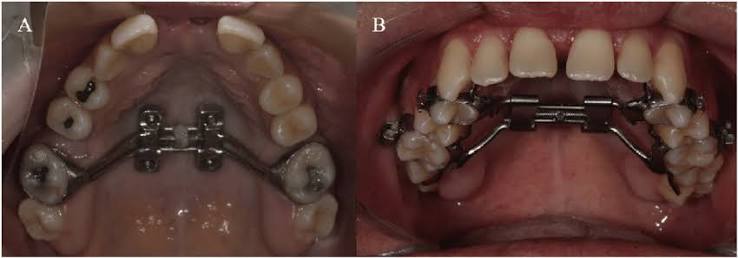
MARPE vs SARPE: How Adult Palate Expansion Options Differ
MARPE vs SARPE: How Adult Palate Expansion Options Differ
MARPE and SARPE are two ways of widening an upper jaw that is too narrow after growth has largely finished. MARPE uses an orthodontic expander supported by miniscrews in the palate. SARPE combines an expander with an operation that releases areas of resistance in the upper jaw. The relevant orthodontic appliances are selected only after the diagnosis and treatment objective are understood.
The key difference is not simply “non-surgical versus surgical”. The real question is which approach can create the required widening safely and predictably for a particular jaw, bite and treatment plan. Neither option is automatically the right one for every adult. An initial consultation is where those questions can be assessed.
Why might an adult need upper-jaw expansion?
An adult may have a crossbite, a side-to-side mismatch between the jaws, crowding or a narrow upper arch. The diagnosis must establish whether the limitation is mainly skeletal, dental or a combination.
Expansion should not be prescribed from appearance alone. The amount, location and symmetry of the narrowing affect what needs to change.
What is MARPE?
Miniscrew-assisted rapid palatal expansion uses temporary anchorage in the palate to direct force towards the upper jaw. The appliance is activated over time and is then held in place while tissues reorganise.
It does not involve the same surgical release as SARPE. It can be considered for selected late adolescents and adults, although the suture may not open and the response can be uneven.
What is SARPE?
Surgically assisted rapid palatal expansion is coordinated between an orthodontist and an oral and maxillofacial surgeon. An expander is fitted and surgery releases selected areas of the mature upper jaw before or around activation.
The exact surgical technique, anaesthesia, activation and recovery instructions are determined by the treating team. SARPE is distinct from a larger orthognathic operation that repositions a jaw in several dimensions, although the broader bite may sometimes require additional planning.
How assessment differs from choosing a product
This is not a menu where a patient selects the less invasive item. Records may include examination, scans, photographs and appropriate three-dimensional imaging. The orthodontist assesses skeletal maturity, width deficiency, facial and dental symmetry, periodontal support and the relationship between both jaws.
The team also considers the consequences of failure. If MARPE does not create the necessary opening, will the delay change the later plan? If surgery is proposed, what does it solve that orthodontic anchorage alone may not?
MARPE and SARPE comparison
| Question | MARPE | SARPE |
| Main mechanism | Miniscrew-supported orthodontic expansion | Surgical release plus expansion |
| Operation | No surgical release of the jaw | Requires an oral and maxillofacial procedure |
| Suitability | Selected mature patients | Mature patients where surgical assistance is indicated |
| Main planning team | Specialist orthodontist, with other clinicians as required | Specialist orthodontist and oral and maxillofacial surgeon |
| Recovery | Appliance adjustment and local tissue adaptation | Surgical recovery plus appliance management |
| Main limitation | Suture may not open, or expansion may be inadequate | Surgical risks and recovery must be considered |
The table describes the broad distinction, not a recommendation. Appliance designs and surgical protocols vary.
What recovery means in each route
With MARPE, early adaptation may involve pressure, tenderness, speech changes, altered eating and extra cleaning around the appliance. Miniscrew areas must be kept clean, and activation follows the prescribed schedule.
SARPE adds recovery from surgery. Swelling, dietary changes, medication and time away from normal activities depend on the procedure and the surgeon’s instructions. Published or anecdotal recovery times should not replace a plan from the treating team.
Risks and uncertainties
MARPE can involve miniscrew loosening, tissue irritation, unwanted dental or periodontal effects, asymmetric change or failure to open the suture. SARPE carries surgical risks as well as appliance-related and orthodontic risks.
Available reviews describe possible side effects, while direct comparison remains limited by the evidence base. That uncertainty is a reason for careful selection, not a reason to treat both options as experimental or equivalent.
What happens after expansion?
Neither route ends when the desired width is reached. The appliance generally remains during a consolidation period, and further braces or aligner treatment may be needed to coordinate the teeth and bite. Retention is planned around the whole orthodontic correction.
The patient should understand the full sequence before choosing a route: records, appliance, activation, monitoring, consolidation, tooth alignment and retention.
How a second opinion can help
Adults often reach this comparison after one clinician has already recommended surgery or after reading that MARPE can avoid it. A second opinion can be useful, but its purpose is not to find the answer the patient prefers. It should test the diagnosis, the amount of expansion needed and the assumptions behind each route.
Bring existing scans, radiographs, treatment letters and medical information if available. The reviewing orthodontist may still need different or updated records, but previous material helps explain how the first recommendation was reached. Ask whether the same treatment objective is being discussed. A plan for modest dental expansion is not equivalent to a plan for correcting a substantial skeletal discrepancy.
If two recommendations differ, ask each clinician to explain the difference in measurable terms. Is the disagreement about diagnosis, expected suture response, acceptable compromise, surgical risk or the patient’s priorities? Clear reasons are more useful than a simple vote between providers.
Coordinating the clinicians
SARPE requires clear communication between the orthodontist and oral and maxillofacial surgeon. The patient should know who fits the appliance, who performs the procedure, when activation begins, who manages post-operative concerns and how progress is shared.
MARPE may also require coordination. General dental and periodontal health must be stable, and another clinician may be involved if imaging or a particular health issue needs review. Names, roles and contact instructions should be documented before treatment starts.
This coordination is particularly important when a patient lives far from the practice. Ask which appointments are time-sensitive, what can be managed remotely and where to seek help after hours. A plan that works clinically must also be workable in real life.
Questions to take to your consultation
Use the consultation to test the diagnosis, the alternatives and the practical implications of each route:
- What is the underlying tooth or jaw problem?
- Which part of the proposed treatment addresses it?
- What reasonable alternatives apply to my case?
- What are the material risks and practical limitations?
- What happens if the expected response does not occur?
- Which other dental or medical practitioners need to be involved?
- What is included in the written fee and what could be separate?
- What retention or follow-up will be needed afterwards?
Take time to understand the answers. Orthodontic treatment is planned over months or years, so a low-pressure decision based on complete information is more useful than choosing quickly from a headline.
Related information from the practice
The practice’s appliance overview provides context for the devices used around expansion. See orthodontic appliances.
Adult treatment may continue with braces or aligners after expansion. See adult orthodontics.
The appointment guide explains how individual records support treatment planning. See initial consultation and records.
Professor Michael Woods spent 28 years as consultant orthodontist to the oral and maxillofacial surgery unit at the Royal Melbourne Hospital. See his clinical background.
Book an initial consultation
Michael Woods Orthodontics is a specialist orthodontic practice on Dandenong Road, on the Malvern/Armadale border. Professor Michael Woods and Dr Nevenka Tadic both hold specialist registration in orthodontics. Bring any existing records to an initial consultation so the team can discuss the concern and the options that may apply.
Call (03) 9509 7496 or use the contact form to request an initial consultation.
Frequently asked questions
Is MARPE better than SARPE?
Not universally. MARPE may avoid surgical release for a suitable patient, while SARPE may be indicated when the required change cannot reasonably be achieved with MARPE.
Can MARPE fail?
Yes. Failure of the suture to open, inadequate or asymmetric expansion and miniscrew or tissue problems are possible.
Is SARPE the same as jaw surgery?
SARPE is a surgical expansion procedure. It is not identical to every form of orthognathic surgery, which may reposition jaws in other directions.
Which option has a faster recovery?
Recovery cannot be compared using a single generic number. MARPE avoids surgical recovery, but it still requires appliance adaptation; SARPE recovery depends on the procedure and the individual.
Can I choose MARPE because I want to avoid surgery?
Preference matters, but anatomy and clinical suitability come first. The consultation should explain whether MARPE can address the actual discrepancy.
Will either option straighten my teeth?
Expansion creates width. Braces or aligners are often still needed to position teeth and coordinate the bite.
Does health insurance cover either treatment?
Benefits vary by policy, item numbers, hospital and surgical cover, waiting periods and limits. Ask for a written plan and check directly with the insurer.
Who plans SARPE treatment?
It is normally coordinated by a specialist orthodontist and an oral and maxillofacial surgeon, with roles explained before treatment.
Leave a Reply