

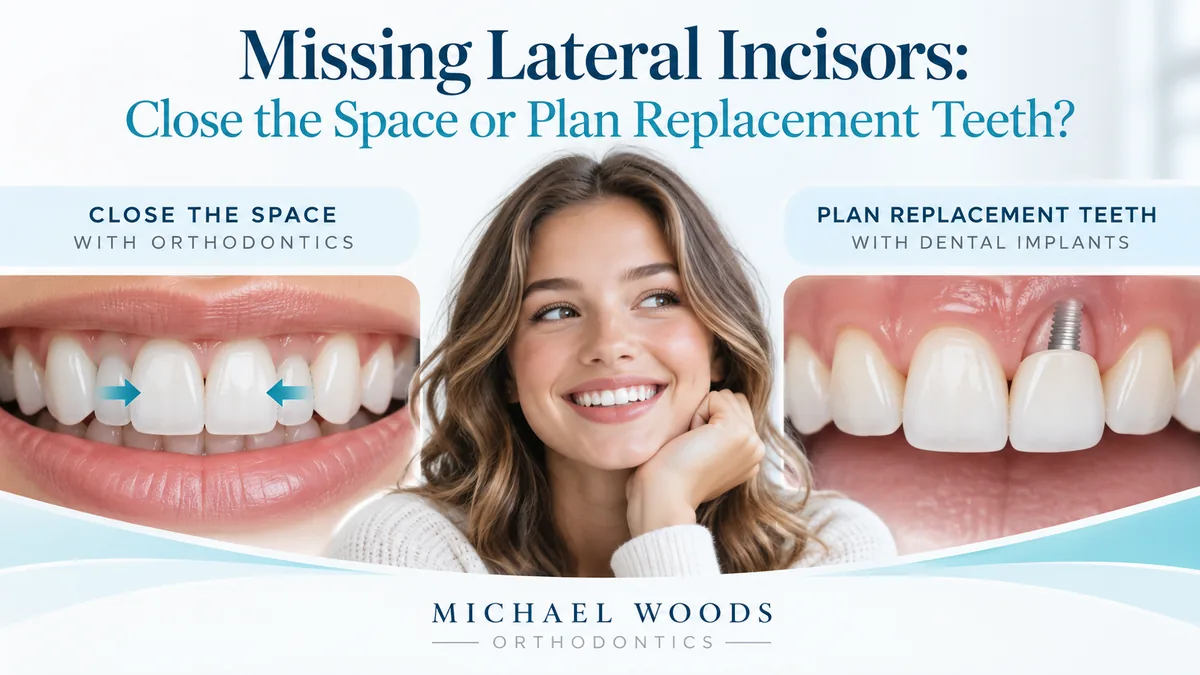
When upper lateral incisors are missing from birth, there are two broad orthodontic pathways: close the spaces and reshape neighbouring teeth, or create and hold suitable spaces for replacement teeth later. Neither is automatically preferable. The decision depends on the bite, facial and dental relationships, the colour and shape of neighbouring teeth, gum and bone conditions, age and the person’s priorities.
We approach missing lateral incisors as a coordinated treatment-planning question, not simply a gap to fill. This article explains how the condition is diagnosed, what space closure and space opening involve, why dental implants must be timed carefully, and which clinicians may contribute to a long-term plan.
What does “missing lateral incisors” mean?
The upper lateral incisors normally sit between the two central front teeth and the canine teeth. Some people are born without one or both because the permanent teeth did not develop. The clinical term is hypodontia or dental agenesis.
The baby lateral incisor may remain for a time, or a gap may appear as permanent teeth erupt. In other cases, neighbouring teeth drift and the missing tooth is discovered only when an X-ray is taken.
Missing lateral incisors can affect more than the visible space. They may influence canine position, dental midlines, bite relationships, gum contours and the room available for a future restoration. That is why we assess both arches rather than measuring one gap.
How do we confirm the diagnosis?
We review eruption history, family patterns, existing baby teeth and previous radiographs. Clinical examination helps us understand space, tooth sizes, canine position, bite and gum architecture. Imaging confirms whether the permanent lateral incisor is absent rather than merely delayed or impacted.
The initial assessment commonly considers:
- whether one or both lateral incisors are absent
- the condition and likely longevity of any retained baby teeth
- crowding or spacing elsewhere
- the position, shape and colour of the canines
- the relationship between upper and lower teeth
- dental and facial midlines
- growth and skeletal maturity
- gum levels and available bone
- planned restorative work or existing dental conditions
Our child orthodontic assessment guide explains why discovering a developmental difference does not always mean treatment begins immediately. Sometimes the first job is to monitor eruption and preserve options.
What are the main treatment paths?
The choice is usually described as space closure versus space opening, but each path contains several decisions.
| Path | What happens | Later care that may be involved |
| Space closure | Canines move into the lateral-incisor positions | Reshaping, colour management or restorative adjustment may be discussed |
| Space opening | Orthodontics creates and positions space for replacement | Resin-bonded bridge, implant or another restorative option may follow |
| Maintain a baby tooth | The retained tooth remains while suitable | Monitoring; another plan if its prognosis changes |
| Mixed or asymmetric plan | Different management on each side in selected cases | Detailed coordination of midlines, bite and restorative work |
The table does not select a treatment. It shows why the orthodontic plan needs to anticipate the final tooth shapes, contacts and restoration rather than moving teeth first and solving the rest later.
How does orthodontic space closure work?
With space closure, the canine is moved forward into the missing lateral incisor’s position. The first premolar then occupies the canine region. Orthodontic mechanics manage the spaces and bite; restorative dentistry may alter the visible shape or colour of the substituted teeth where appropriate.
Space closure may be considered when the overall bite, crowding, profile, canine appearance and tooth-size relationships support it. It avoids placing a replacement tooth in the missing site, but it does not mean there is no long-term care. Tooth reshaping or additive restorative work may need review over time.
Questions we consider include:
- Can the canine reasonably resemble a lateral incisor after planned modification?
- Will the first premolar function acceptably in the canine region?
- How will space closure affect the bite and midlines?
- Does the patient already have crowding that space closure could help manage?
- Are the gum levels and tooth proportions compatible with the plan?
These points are assessed together. A single photograph cannot show root positions or bite relationships well enough to decide.
What does opening space for replacement involve?
Space opening moves teeth into positions that allow a future replacement lateral incisor. The orthodontist must create the right space at crown and root level. A visible gap of the correct width is not enough if adjacent roots converge beneath the gum.
The restorative dentist or prosthodontist may contribute early so the team agrees on intended tooth width, gum contour, root clearance and provisional options. Replacement choices can include a resin-bonded bridge, an implant-supported crown after growth, or another restoration suited to the individual situation.
The American Association of Orthodontists notes that orthodontic treatment may close missing-tooth space or create and preserve space for replacement, often with coordination between dental clinicians. That collaborative sequence is central to planning missing lateral incisors.
Why is implant timing important?
A dental implant is integrated with bone and does not move like a natural tooth under orthodontic force. It also does not follow future jaw growth in the same way as neighbouring teeth. For a growing patient, placement is generally considered only after growth and site development have been assessed by the relevant clinicians.
This timing creates a practical question: what occupies the space between orthodontics and the final restoration? Depending on the plan, a temporary tooth may be carried in a removable retainer, attached provisionally or managed another way. The team should discuss appearance, cleaning, durability and replacement needs before active orthodontics ends.
We do not provide a universal age for implants. Skeletal maturity, site conditions and restorative assessment matter more than a birthday.
How do age and growth affect the choice?
Diagnosis often occurs during childhood or adolescence, while definitive treatment decisions may span several years. Early planning protects space and eruption pathways without forcing the final choice prematurely.
| Stage | Typical planning focus |
| Mixed dentition | Confirm absence, monitor eruption and avoid accidental loss of options |
| Adolescent orthodontic stage | Coordinate spaces, roots, bite and provisional tooth needs |
| Growth completion | Reassess implant or definitive restorative suitability where relevant |
| Adult presentation | Consider existing drift, gum and bone health, restorations and bite |
An adult can still seek assessment for missing lateral incisors. The plan may involve reopening collapsed space, closing residual gaps or working around existing restorations.
Which clinicians may be involved?
The orthodontist plans tooth movement and bite relationships. The general dentist maintains dental health and may provide restorative care. A prosthodontist may contribute to complex replacement planning, a periodontist to gum or site considerations, and an oral surgeon to implant placement where that route is selected.
Coordination should answer:
- What is the agreed final arrangement?
- Which tooth will occupy each position?
- What root spacing and gum contour are required?
- Who provides a temporary tooth, and when?
- When is growth considered complete enough for the next decision?
- Who monitors retainers and restorative work afterwards?
The patient’s general dentist remains involved throughout. Orthodontic care does not replace routine examinations, prevention or treatment of decay.
What risks and limitations should be discussed?
All pathways have trade-offs. Orthodontic treatment may involve discomfort, enamel or gum risks if cleaning is poor, root changes, appliance breakage and relapse. Space closure may require compromises in tooth shape or colour management. Space opening commits the patient to a temporary and later restorative pathway, with future maintenance and replacement needs.
A retained baby tooth may last for a variable period but cannot be promised for life. Implants and bridges also need ongoing care and are not lifetime guarantees. The consent discussion should cover the material issues for the chosen plan and the reasonable alternative of no treatment where applicable.
What should a written plan explain?
Before treatment begins, we want the destination to be understandable. A plan should address:
- whether space will be opened, closed or maintained
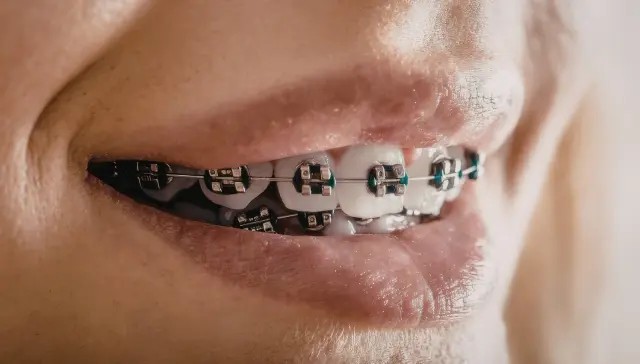
- the proposed appliance and movement objectives
- which restorative work is expected
- how appearance is managed during any waiting period
- the roles of each clinician
- the likely stages rather than an exact promised completion date
- retention after orthodontic movement
- what is included in each provider’s estimate
- what could cause the plan to change
Fees vary with diagnosis, records, appliance, complexity and care supplied by other clinicians. We provide an individual estimate after assessment and do not publish an unsupported average.
How does retention work afterwards?
Teeth can move after active orthodontics. Retainers are therefore part of both space closure and space-opening pathways. When a replacement tooth is pending, the retainer may also carry a temporary tooth or preserve the site.
Our retainer information explains the types used by the practice. The individual wear schedule depends on the original arrangement, treatment and ongoing risk of movement.
If a retainer is lost, damaged or no longer fits, call before forcing it. Small changes in space can matter when a restoration has been planned to a particular width.
Questions to bring to the consultation
- Are the lateral incisors definitely absent?
- What happens if we monitor for now?
- What supports space closure in this case?
- What supports creating space for replacement?
- How will the canine shape and colour affect closure?
- When will the restorative dentist contribute?
- What temporary tooth options are available?
- How will growth be assessed before an implant decision?
- What maintenance will each option require over time?
There may be more than one reasonable answer. The consultation should make the trade-offs visible without pressuring you towards a particular restoration.
Book a coordinated orthodontic assessment
Missing lateral incisors benefit from planning that begins with the final tooth and bite arrangement. Michael Woods Orthodontics is a specialist orthodontic practice with two specialist orthodontists, based on Dandenong Road on the Malvern/Armadale border.
Professor Michael Woods spent 28 years as consultant orthodontist to the oral and maxillofacial surgery unit at the Royal Melbourne Hospital. This is a verifiable part of his clinical background, not a claim about what any individual treatment will achieve.
Call us on (03) 9509 7496 or book an initial consultation. Bring available X-rays, referral information and details of any restorative plan already discussed.
Frequently asked questions
1. Are missing lateral incisors hereditary?
Family patterns can occur, although a relative without the condition does not rule it out. Examination and imaging confirm whether the teeth developed.
2. Is an implant always the most suitable replacement?
No. Space closure, bridges, retained baby teeth and implant-supported replacement may be considered. Growth, bite, bone, gum and patient factors influence suitability.
3. Can clear aligners manage the spaces?
They may be an option in selected cases, but appliance choice follows the required root and crown movements. Fixed appliances or auxiliaries may offer advantages in other cases.
4. Can treatment wait until adulthood?
Sometimes monitoring is reasonable, but early assessment can protect eruption and space options. Waiting without a plan may allow neighbouring teeth to drift.
Leave a Reply