

Can You Get Braces With Gum Disease?
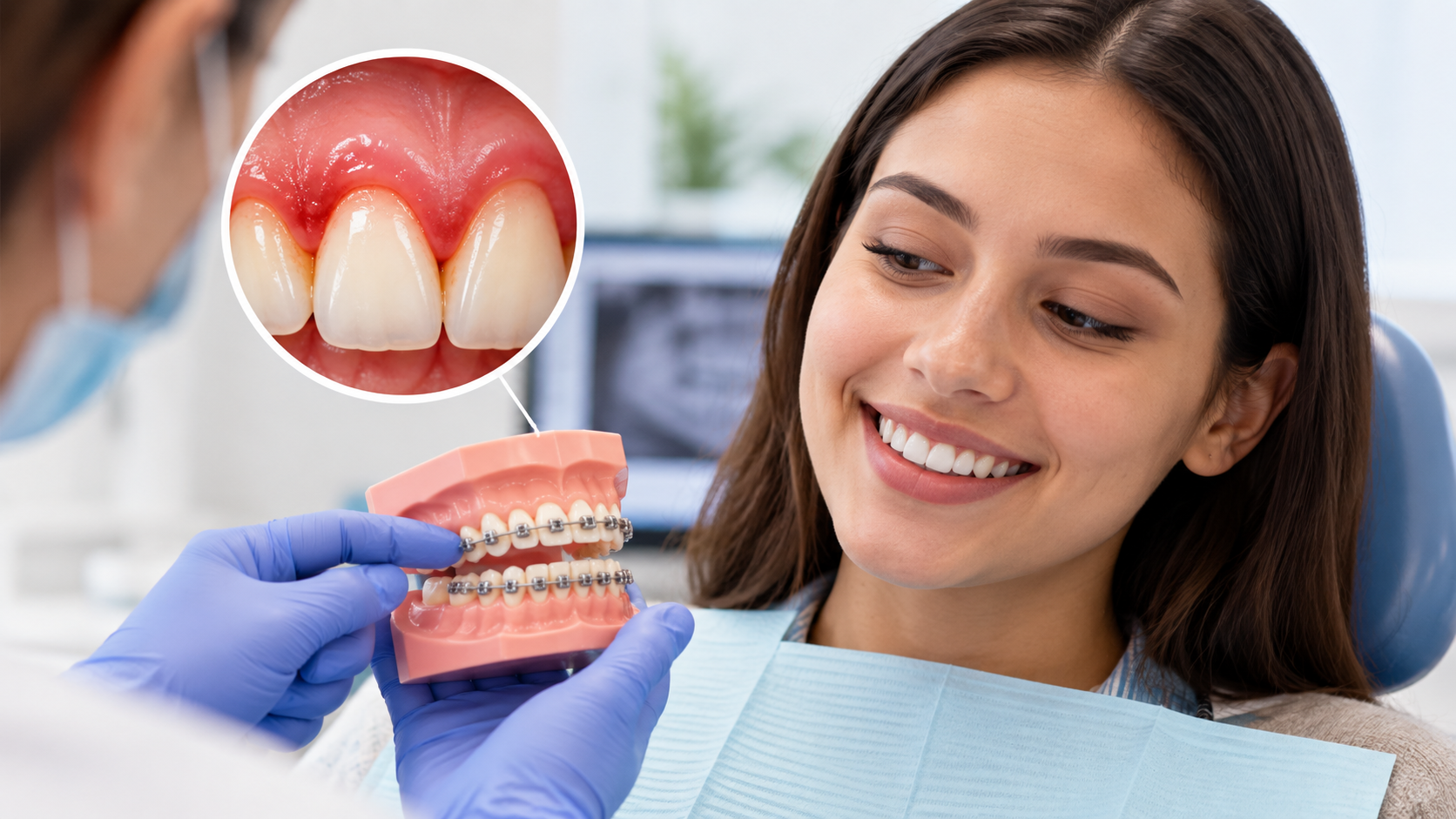
It may be possible to have orthodontic treatment after gum disease has been assessed and brought under suitable control. Active, unstable periodontal disease usually needs treatment before teeth are deliberately moved. Starting braces while inflammation and supporting-bone loss are uncontrolled can add avoidable risk.
We do not make this decision from bleeding alone or from the appearance of straight teeth. We consider gum inflammation, bone support, tooth mobility, cleaning ability and the objectives of movement, often in consultation with a general dentist or periodontist. This guide explains what must be checked, how treatment may be adapted and what ongoing maintenance involves.
What do we mean by gum disease?
Gingivitis is inflammation of the gums, often associated with plaque, without the attachment and bone loss that defines periodontitis. It can cause redness, swelling and bleeding. Periodontitis affects the structures supporting the teeth and can lead to gum recession, pockets, bone loss, mobility and changes in tooth position.
The distinction matters because “my gums bleed” does not describe severity or stability. Some people have visible inflammation without established bone loss; others have significant periodontal disease with few symptoms. The American Academy of Periodontology notes that periodontal disease can be relatively silent and lists signs including bleeding, recession, loose or separating teeth, persistent bad breath and bite changes.
Assessment by the appropriate dental clinician is needed before deciding about braces with gum disease.
Why does periodontal stability matter before tooth movement?
Orthodontic force causes controlled biological change in the tissues around a tooth. Those tissues need to be healthy enough for movement and monitoring. Active inflammation, heavy plaque and unstable periodontal support change the risk picture.
The first objectives are therefore:
- diagnose whether disease is present and how extensive it is
- control inflammation and address relevant risk factors
- establish whether bone and attachment levels are stable
- confirm the person can clean effectively
- decide whether the proposed movement is appropriate for the remaining support
- agree on periodontal maintenance during orthodontics
This sequence is not a punishment or an obstacle. It is part of deciding whether elective movement is responsible.
What signs should be checked before an orthodontic consultation?
Tell your general dentist and us if you have noticed:
- bleeding during brushing or interdental cleaning
- persistent red, swollen or tender gums
- recession or teeth looking longer
- loose teeth or new spaces
- pus near the gumline
- persistent bad breath or unpleasant taste
- a change in how the teeth meet
- previous deep cleaning, gum surgery or periodontal maintenance
- smoking, diabetes or medicines relevant to oral health
Do not stop prescribed medicine or change periodontal treatment because you are considering orthodontics. Bring recent records and the contact details of the clinicians already involved.
Who assesses the gums?
Your general dentist may perform the initial periodontal assessment and routine care. A periodontist is a registered dental specialist in conditions affecting the gums and supporting structures. Referral depends on the findings and complexity.
The orthodontist assesses tooth position, bite, planned forces and how remaining support affects movement. Good care often requires communication rather than one clinician attempting to perform every role.
| Clinician | Typical responsibility in coordinated care |
| General dentist | Routine examinations, decay management, cleans and overall dental care |
| Periodontist | Diagnosis and management of complex or advanced periodontal disease |
| Orthodontist | Movement objectives, appliance design, force system and bite planning |
| Patient | Daily plaque control, attendance and reporting changes |
The American Academy of Periodontology describes a team approach between the general dentist and periodontist for periodontal care. Orthodontic involvement adds another defined role when tooth movement is being considered.
What needs to happen before braces?
The answer depends on the diagnosis. Initial care may involve oral-hygiene instruction, professional cleaning, scaling and root planing, risk-factor management or periodontal procedures. The AAP’s overview of non-surgical periodontal treatment explains that scaling and root planing cleans beneath the gumline and that ongoing maintenance may still be required.
Before orthodontics, the treating team may look for:
- Reduced bleeding and inflammation.
- Stable periodontal measurements over an appropriate review period.
- A daily cleaning routine the patient can maintain.
- Completion of necessary decay or infection treatment.
- Agreement on teeth with uncertain long-term prognosis.
- A maintenance interval during active orthodontics.
There is no single waiting period that applies to everyone. The periodontist or dentist advises when disease is suitably controlled for the proposed plan.
Can teeth with reduced bone support be moved?
Selected teeth with reduced but stable support may sometimes be moved under a carefully planned, coordinated approach. Reduced support changes biomechanics: the centre of resistance shifts, forces may need to be lighter, and movement objectives may be more limited.
This does not mean braces can rebuild lost periodontal support, nor should orthodontics be advertised as a cure for periodontitis. The question is whether controlled movement can be performed within the conditions present after disease management.
Some teeth may have a guarded prognosis. The team may need to decide whether to retain them, use them temporarily, extract them or alter the movement plan. Those are individual consent decisions, not rules that can be settled in a general article.
Are clear aligners safer than fixed braces for gum disease?
Removable aligners can make brushing and interdental cleaning more accessible because they are taken out. Fixed braces provide continuous control but create additional surfaces around brackets and wires. Neither appliance makes active periodontal disease safe, and neither eliminates the need for maintenance.
| Consideration | Fixed braces | Clear aligners |
| Cleaning access | Requires cleaning around brackets and wires | Trays can be removed for cleaning |
| Wear responsibility | Appliance remains in place | Depends on consistent prescribed wear |
| Force and movement control | Can suit a wide range of planned mechanics | Suitability varies with movement and case |
| Gum monitoring | Tissues remain visible, but plaque traps increase | Trays must be removed for examination and kept clean |
| Disease requirement | Periodontal stability remains necessary | Periodontal stability remains necessary |
Our ceramic braces versus clear aligners guide compares daily responsibilities in more detail. We choose an appliance after the diagnosis, not on the assumption that removable always means lower risk.
How may the orthodontic plan be modified?
For a periodontally affected adult, we may discuss fewer or more limited movements, lighter forces, additional monitoring or a different appliance. In some cases, aligning teeth can be coordinated with restorative or periodontal objectives; in others, the responsible advice is to defer or not proceed.
Possible adaptations include:
- shorter intervals for periodontal review
- simpler appliance components that improve cleaning access
- staged movement rather than activating many areas at once
- avoiding movement beyond the available supporting tissues
- splinting or retention plans suited to mobility risk
- coordination of extractions and restorative treatment
- pausing active movement if inflammation returns
This is one reason specialist assessment matters. The method must respond to the periodontal diagnosis and movement required.
What does daily care involve during treatment?
The exact instructions come from the treating team, but the routine generally includes thorough brushing, interdental cleaning and professional maintenance. A standard toothbrush alone may not reach around every bracket, contact and gum margin.
A practical daily checklist is:
- brush as directed with fluoride toothpaste
- clean between teeth with the method recommended for your spaces
- clean around brackets, wires or attachments carefully
- remove and clean aligners before replacing them
- avoid smoking and seek cessation support where relevant
- monitor bleeding, swelling, mobility and recession
- attend periodontal, dental and orthodontic reviews
Bleeding should not be used as a reason to stop cleaning indefinitely, but painful or worsening symptoms deserve professional advice. Your dentist or periodontist can demonstrate a method suited to your mouth.
What happens if the gums become inflamed during braces?
Tell the team early. The response may include hygiene review, professional cleaning, periodontal reassessment, changes to the appliance or a pause in active tooth movement. Continuing unchanged is not always appropriate.
Contact your clinician promptly for increasing mobility, swelling, pus, marked recession, persistent bleeding or a new bite change. Severe facial swelling, fever, difficulty swallowing or breathing requires urgent medical or dental attention.
We prefer clear responsibility: which clinician checks gum measurements, how often, and how information is shared. “Keep an eye on it” is not a maintenance plan.
What risks should be discussed?
Orthodontic treatment has general risks including discomfort, decay or gum problems with poor cleaning, root changes, relapse and appliance breakage. Existing periodontal loss can add risks of further attachment loss, recession, mobility or an outcome that requires treatment to be altered or stopped.
No appliance can guarantee stability. Doing nothing also has consequences that depend on the bite, disease and tooth positions, so both treatment and non-treatment should be discussed in context.
We avoid statements that straightening teeth will automatically improve gum health. Alignment may make some surfaces easier to access, but disease control still depends on plaque management, professional care and individual risk factors.
Questions to ask before starting
- Is my diagnosis gingivitis or periodontitis?
- Is the disease stable enough for the proposed movement?
- Which teeth have reduced support or uncertain prognosis?
- Does my periodontist agree with the treatment objectives?
- Which appliance gives appropriate control and cleaning access?
- How frequently will periodontal maintenance occur?
- What findings would make treatment pause or change?
- Who handles an urgent gum concern?
- What type of retention will be needed afterward?
A written plan should also clarify fees across providers, because periodontal care and general dentistry are usually separate from the orthodontic estimate.
Book an adult orthodontic assessment
Our adult orthodontics information outlines the treatment approaches available at Michael Woods Orthodontics. An initial consultation does not commit you to braces, and braces with gum disease are not recommended until the supporting-health questions have been answered.
Call us on (03) 9509 7496 or send an appointment enquiry. Bring recent periodontal records and details of your dentist or periodontist. Our practice is on Dandenong Road, on the Malvern/Armadale border.
Frequently asked questions
1. Can braces cause gum disease?
Braces do not create periodontitis by themselves, but fixed components can make plaque removal harder. Poor plaque control can contribute to inflammation and dental disease, so cleaning and professional reviews are important.
2. Do bleeding gums mean I cannot have orthodontic treatment?
Not automatically. Bleeding requires assessment of its cause and severity. Treatment may proceed after inflammation or periodontal disease is appropriately managed and stable.
3. Can I use clear aligners instead?
Possibly, if the planned movement and your ability to wear them consistently make aligners suitable. They do not bypass the need for periodontal stability.
4. Will orthodontics fix loose teeth?
It should not be promised as a treatment for tooth mobility. The cause and periodontal prognosis need assessment first, and some movement may be inappropriate.
Leave a Reply