

Broken Retainer: What to Do, What to Avoid and When to Call
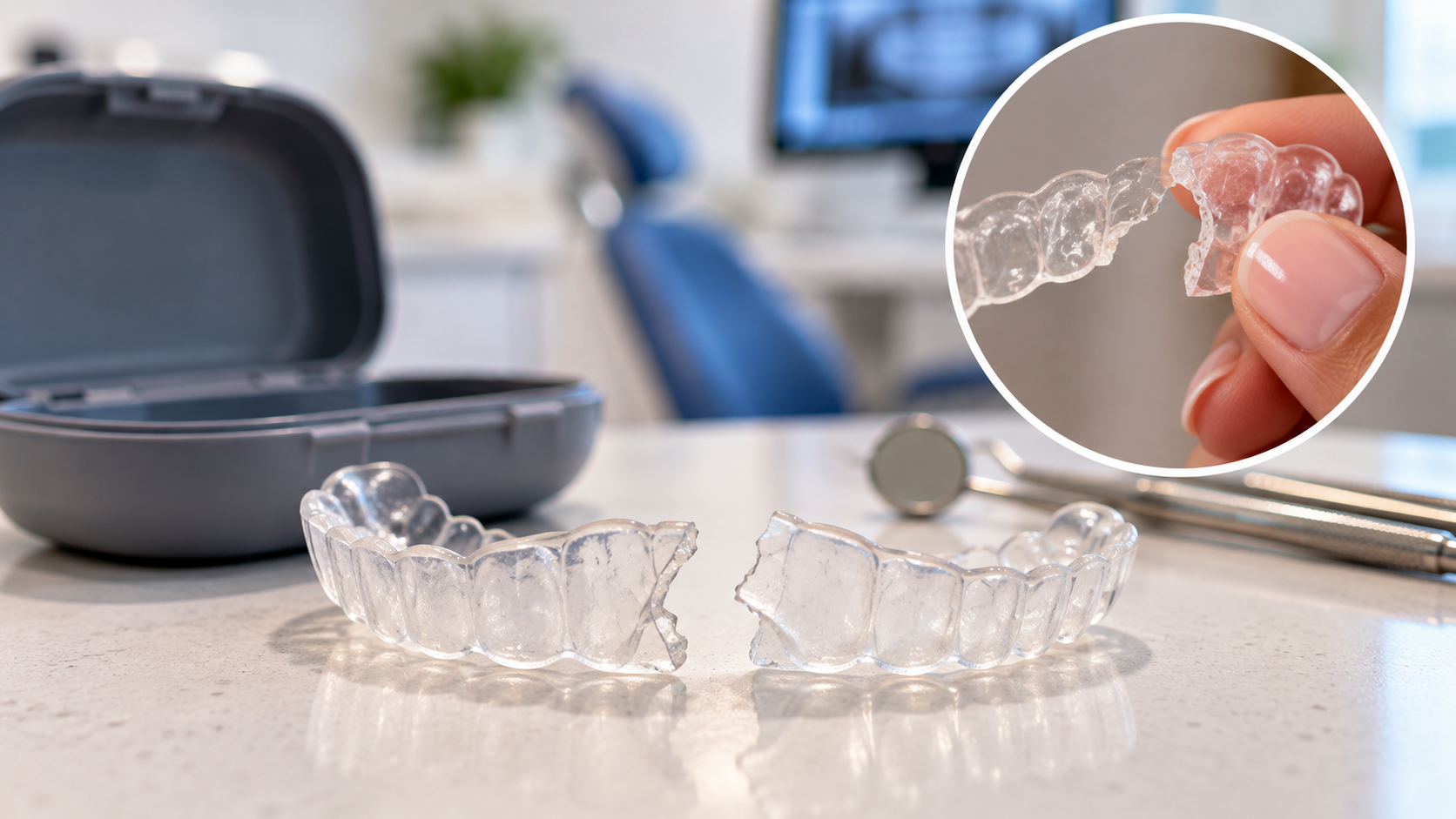
If you are searching for “broken retainer what to do”, the short answer is: stop wearing it if it is sharp, distorted, very loose or no longer fits; keep every piece safely; and call your orthodontic practice for advice. Do not glue, heat, trim or bend it at home. A damaged appliance may stop retaining correctly and can sometimes injure the mouth or apply unwanted pressure.
Not every crack has the same consequence, and not every broken retainer is an after-hours emergency. We need to know whether it is removable or fixed, what has failed, whether it still seats and whether the teeth have begun to move. This guide leads you through those questions and explains how we decide between repair, replacement and further assessment.
First, identify which type of retainer has broken
The word “retainer” covers several appliances. Knowing which one you have helps us give useful advice when you call.
| Retainer type | What it looks like | Common problem |
| Clear removable retainer | Transparent plastic shell over the teeth | Crack, split, distortion or poor fit |
| Hawley-style retainer | Acrylic plate with a wire around the teeth | Bent or broken wire, cracked acrylic |
| Fixed or bonded retainer | Thin wire attached behind front teeth | Adhesive detaches, wire bends or breaks |
If you are unsure, describe whether you can remove it and where the damage sits. A photograph may help the practice understand the immediate issue, although it does not replace an examination.
What should I do right now?
When someone calls us about a broken retainer, we work through a simple safety sequence. You can use the same order while arranging advice.
- Remove a removable retainer carefully. If it is stuck, painful or caught, do not use force; call the practice.
- Check your mouth. Look for a cut, bleeding, swelling or a loose piece that could be swallowed.
- Keep the appliance and all pieces. Place them in a clean retainer case rather than wrapping them in tissue.
- Do not repair it yourself. Household adhesives and heat are not suitable for an appliance worn in the mouth.
- Call the orthodontic practice. Explain the retainer type, damage, fit and any symptoms.
- Follow case-specific instructions. We may advise an appointment, temporary wear of another supplied retainer or leaving the damaged appliance out.
If a piece has been inhaled, breathing is difficult, or there is significant uncontrolled bleeding, seek urgent medical care.
Should I keep wearing a cracked removable retainer?
It depends on the crack and fit, which is why telephone advice should be specific. A tiny superficial mark is different from a split that opens when the retainer is flexed.
Stop wearing it and contact us if:
- it has a sharp edge that cuts the tongue, cheek or gum
- it is split through or has a piece missing
- it rocks, lifts or no longer seats fully
- it feels dramatically tighter than before
- its shape has changed after heat exposure
- Wearing it causes significant or increasing pain
- You cannot remove it normally
Do not file or cut the edge unless your treating orthodontic team specifically instructs you. Removing material can weaken the retainer or change how it holds the teeth.
What if a fixed retainer comes loose?
A fixed retainer can detach from one tooth while remaining bonded to the others. It may feel rough under the tongue, and the affected tooth may no longer be held. The wire can also distort even when the adhesive pads appear intact.
For a loose fixed retainer:
- avoid pulling, twisting or repeatedly testing the wire
- avoid hard or sticky food around the affected area
- continue gentle cleaning without snagging the wire
- use orthodontic wax temporarily if a projection is rubbing and you have been shown how
- Call us to arrange an assessment
A loose bonded wire should not simply be covered indefinitely. We need to check whether the wire is passive, whether teeth have moved and whether repair or replacement is appropriate.
Can I glue my retainer back together?
No. Household glue is not designed for prolonged contact with oral tissues, and joining the pieces can lock in a distorted shape. The visible crack may also be only part of the damage.
Other home fixes to avoid include:
| Do not | Why it creates a problem |
| Put the retainer in hot water | Heat can permanently distort plastic |
| Bend a wire with pliers | The force and shape cannot be controlled clinically |
| Bite the appliance into place | This may crack it further or load teeth incorrectly |
| Trim a split with scissors | The retainer may become sharp, weak or ineffective |
| Wear only one broken section | It may retain some teeth while others move |
| Use another person’s retainer | Retainers are made for an individual mouth |
Searching “broken retainer what to do” often produces improvised repair videos. A repair that looks neat is not necessarily accurate enough to hold tooth position safely.
How quickly can teeth move without a retainer?
There is no single timetable. The risk depends on how recently active treatment ended, the original tooth positions, the type of movement completed, age, biology and the other retention in place.
Movement can occur before it is obvious in a mirror. A replacement made after the teeth have changed may fit the new position rather than the intended one. Contacting us promptly therefore preserves choices, even when an appointment is not required on the same day.
Recent treatment generally deserves particular attention because tissues are still reorganising. Long-term retainer wear remains important too, since teeth can change throughout adulthood.
Is a broken retainer an orthodontic emergency?
Most broken retainers require timely advice rather than emergency medical care. The following table helps separate situations, but you should call if uncertain.
| Situation | Usual level of response |
| Small crack, retainer still comfortable and fully seated | Call during business hours for instructions |
| Retainer split, distorted or no longer fitting | Stop forcing it and arrange prompt assessment |
| Fixed retainer detached from a tooth | Call promptly; avoid pulling the wire |
| Sharp wire cutting the mouth | Contact the practice for same-day advice where possible |
| Swallowed small piece with no symptoms | Seek medical advice and inform the practice |
| Suspected inhalation, choking or breathing difficulty | Call 000 immediately |
Pain, swelling or injury may come from a dental problem rather than the retainer itself. An orthodontic appliance should not delay appropriate dental or medical assessment.
What happens at the appointment?
Please bring the damaged retainer and every piece you can find. We examine the appliance and the mouth before deciding what to make.
The review may include:
- checking whether teeth have shifted
- assessing how the upper and lower teeth meet
- inspecting gum and tooth health
- checking every bond on a fixed retainer
- comparing with previous records where useful
- taking a digital scan or impression for a replacement
- discussing whether another retainer type would suit the situation
At Michael Woods Orthodontics, digital scanning may be used where appropriate instead of a physical impression. The method is secondary to obtaining an accurate record of the current teeth and deciding whether that is the position we want to retain.
Can the retainer be repaired, or will it need replacing?
Some fixed retainers can be rebonded, and selected wire-and-acrylic appliances may be repairable by a dental laboratory. A clear plastic retainer that is split or distorted commonly needs replacement rather than patching.
The decision depends on:
- the material and location of the damage
- the appliance’s age and overall condition
- whether the retainer still fits accurately
- whether the teeth have moved
- whether the original design still suits the retention plan
- oral hygiene and the condition of the supporting tissues
We will not assume that replacing the same design is always the answer. A repeated breakage may indicate wear, handling, grinding, food forces or a design issue worth reviewing.
What if my teeth have already moved?
If movement has occurred, forcing a replacement over the old position is not appropriate. We assess the amount of change, the bite and what you want to address.
Possible pathways include accepting the current position and retaining it, limited tooth movement with an appropriate appliance, or more comprehensive retreatment when the change is broader. These are not interchangeable products. Each has different limitations, risks and retention requirements.
Our guide to teeth shifting after braces explains why relapse can happen and how an orthodontic assessment separates minor movement from a wider bite change.
How can I reduce the chance of another breakage?
No retainer lasts forever, but handling makes a meaningful difference. A simple routine includes:
- place a removable retainer in its ventilated case whenever it is out
- keep it away from hot water, heaters and direct heat
- clean it using the method recommended for its material
- keep it away from pets and young children
- do not wrap it in a napkin during meals
- remove it as demonstrated rather than twisting one side
- avoid biting directly into place
- check fixed wires during daily cleaning
- bring retainers to orthodontic reviews
If you clench or grind, tell us rather than assuming the retainer should double as a grinding appliance. Different appliances serve different purposes.
Call us before attempting a home repair
When you need a clear answer to “broken retainer what to do”, start by keeping the appliance safe and contacting the practice that can assess it. Michael Woods Orthodontics has two specialist orthodontists and is located on Dandenong Road, on the Malvern/Armadale border.
Call us on (03) 9509 7496 or book an appointment. Tell us which retainer you have, what broke, and whether it still fits, and we will guide you towards the appropriate next step.
Frequently asked questions
1. Can I wear my previous retainer while I wait?
Only if your orthodontic team advises it. An earlier retainer may no longer reflect the intended tooth position or may fit differently after dental work.
2. What if I am travelling?
Keep the broken appliance, take clear photographs and call us. We can advise whether the issue can wait and whether a local dentist or orthodontist should examine it.
3. Can a dentist replace my retainer?
Some dentists provide retainers. When tooth movement, a changed bite or a complex original correction is involved, specialist orthodontic assessment can help determine the correct position and retention design.
4. Will I be charged for a replacement?
Fees depend on the appliance and circumstances. We do not quote an unverified figure in a general article; the practice can explain the current fee after identifying what is required.
5. Should I wait until my next scheduled review?
Call now rather than deciding alone. The team may advise that the planned review is soon enough, or arrange an earlier appointment based on fit, damage and timing.

Leave a Reply