

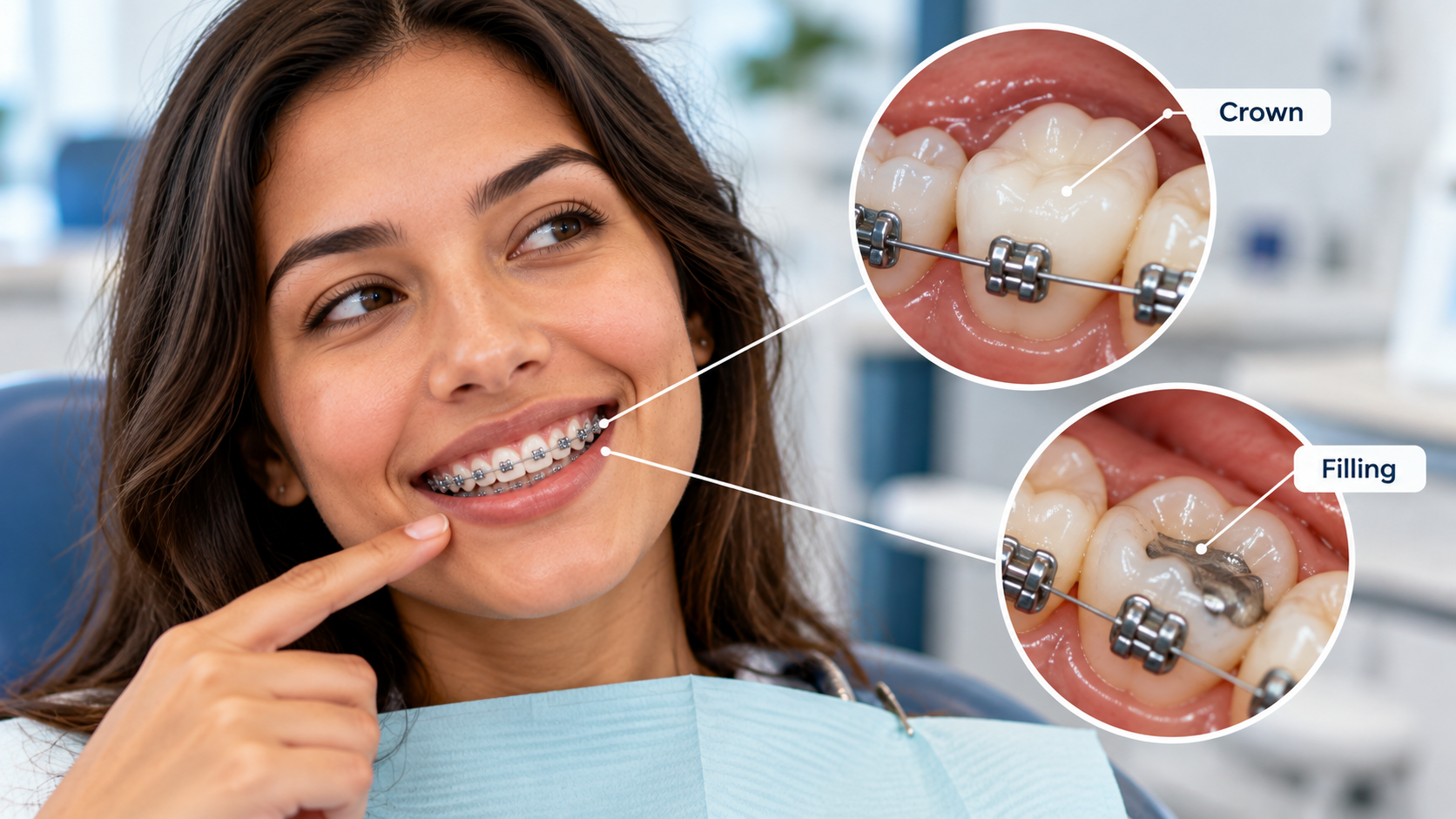
Can You Have Braces with Crowns and Fillings?
In many cases, adults can have braces with crowns and fillings. Restored teeth can often be moved orthodontically, but the material on the tooth, the health of the root and gum, and the wider dental plan all matter. An implant is different because it is fused to bone and does not move like a natural tooth.
We therefore plan around the whole mouth, not simply the visible alignment. In this article, we explain how common dental restorations affect braces and aligners, what should be checked before treatment, and why your orthodontist and general dentist may need to coordinate care.
Why existing dental work changes the planning conversation
A filling repairs part of a tooth. A crown covers much of the visible tooth. A bridge connects replacement teeth to supporting teeth, while an implant-supported crown is anchored to an implant in bone. These restorations do not all behave in the same way.
Before recommending braces with crowns and fillings, we consider:
- whether each tooth and restoration is healthy
- the material and shape of the restoration
- gum and bone support around the tooth
- previous root canal treatment or trauma
- where brackets or attachments would need to bond
- whether a bridge or implant limits movement
- dental work planned after orthodontics
- how the bite contacts restored teeth
Can an orthodontist move a crowned tooth?
A natural tooth with a crown still has a root and periodontal ligament. If the tooth and supporting tissues are suitable, orthodontic force can usually move it. The crown itself does not make the root immovable.
However, the crown may affect bracket bonding and bite contacts. Porcelain, ceramic, metal and composite surfaces require different preparation, and bonding may be less predictable than on natural enamel. We use an approach appropriate to the restoration and remove attachments carefully at the end.
The underlying tooth must also be assessed. A crowned tooth may have a large previous restoration, a root filling, a post or a history of fracture. Those facts do not automatically prevent movement, but they influence risk and monitoring.
What about ordinary fillings?
Small fillings often make little difference to orthodontic treatment. Larger restorations can change the surface available for a bracket or aligner attachment, and a damaged or leaking filling may need attention before appliances are fitted.
We look at location as well as size:
| Restoration | Possible orthodontic consideration |
| Small filling away from bonding surface | Often little practical effect |
| Large front-tooth composite | Attachment position and removal need care |
| Large back-tooth filling | Bite forces and restoration condition matter |
| Temporary filling | Definitive dental treatment may be needed first |
| Recently placed restoration | Orthodontist and dentist may coordinate timing |
If a filling breaks during treatment, contact your dentist and tell us. Appliance wires or aligners may need temporary adjustment so the tooth can be restored accurately.
Are clear aligners easier with crowns?
Clear aligners avoid brackets on every tooth, but they are not automatically simpler. Many aligner plans require small tooth-coloured attachments bonded to selected teeth. A crown may still need an attachment, and bonding to its surface can be less predictable.
Aligners also depend on consistent wear and suitable tooth movements. Fixed braces can sometimes provide different control. Appliance choice should be based on the bite and treatment objective, not the assumption that one material is always safer for restorations.
Our discussion of ceramic braces and clear aligners explains practical differences between two discreet options for adults. Existing dental work becomes another part of that comparison.
Can teeth with root canal treatment move?
A successfully root-treated natural tooth can often be moved orthodontically. We assess the tooth’s history, restoration, root, surrounding bone and any symptoms. Current radiographs may be needed when clinically justified.
Root canal treatment removes tissue from inside the tooth; it does not remove the periodontal ligament around the root. That ligament is involved in orthodontic movement. Nevertheless, a previously injured or heavily restored tooth may need closer review.
Tell us about prior trauma even if it happened many years ago. A tooth that looks ordinary may have a relevant history that is not obvious from appearance alone.
Why implants are different
A dental implant is joined directly to bone and has no periodontal ligament. It cannot be moved with braces or aligners in the way a natural tooth can. Instead, it may serve as a fixed reference point, or its position may constrain the plan.
This makes treatment order important. Where an implant is planned but not yet placed, orthodontics may first create or refine the space and root positions. Our guide to orthodontics before dental implants explains why implant placement is often coordinated after tooth movement.
If an implant already exists, we examine whether the natural teeth can be arranged around it and whether the final bite will be acceptable. Sometimes restorative modification is part of the broader plan.
What about bridges and dentures?
A conventional bridge joins two or more units, so the supporting teeth cannot be moved independently without altering or removing the bridge. We need to understand which teeth are connected and whether the bridge is intended to remain.
A removable partial denture may need adjustment as teeth move. It may continue to provide temporary appearance or function, but its fit can change during treatment. Coordination with the restoring dentist helps avoid surprises.
| Dental work | Does it move like a natural tooth? | Planning issue |
| Crown on a natural tooth | Usually, if tissues are suitable | Bonding and tooth history |
| Filling in a natural tooth | Usually | Restoration condition and attachment position |
| Root-treated natural tooth | Often | Root, restoration and trauma history |
| Dental implant | No | Fixed position constrains space and bite |
| Conventional bridge | Units are connected | Independent movement may not be possible |
| Removable denture | Not orthodontically moved | Fit may change as teeth move |
What should happen before orthodontic treatment?
Healthy teeth and gums provide the foundation for treatment. Before braces with crowns and fillings begin, your general dentist may need to complete an examination, cleaning or necessary treatment.
A sensible sequence can include:
- orthodontic assessment of alignment, bite and proposed movement
- dental assessment of decay, restorations and gum health
- exchange of relevant records or treatment objectives
- completion of urgent or foundational dental care
- orthodontic records and final appliance planning
- agreement about restorations to be completed during or after treatment
Not every crown needs replacing before orthodontics. In some cases, a provisional shape is maintained until tooth positions are final, then definitive restorative work is completed. The right order depends on why the restoration is needed.
How do brackets attach to crowns?
Bonding protocols depend on crown material. The surface may require specific cleaning, conditioning and adhesive. Even with appropriate technique, a bracket on a restoration may detach more readily than one bonded to intact enamel.
If a bracket comes loose, keep it attached to the wire if it is sitting safely and call us. Do not use household adhesive. We will inspect both the bracket and crown surface before rebonding or changing the approach.
At removal, care is taken to reduce the risk of scratching or damaging the restoration. No bonding or removal technique can be described as risk-free, which is why we discuss material and condition first.
How do you clean around braces and restorations?
Plaque control is important around every bracket, and especially around crown margins, bridgework and larger restorations. We demonstrate cleaning for the appliance you receive.
Your routine may include:
- brushing along the gumline and around all sides of brackets
- using interdental brushes beneath wires where appropriate
- cleaning under bridgework with a suitable threader or aid
- removing aligners before eating and cleaning teeth before reinsertion
- following fluoride advice from your dental team
- maintaining dental check-ups throughout orthodontic care
Could a crown need changing after orthodontics?
Possibly. Moving the tooth may reveal that an old crown shape, contact or margin no longer suits the final relationship. A crown made to disguise a rotated or spaced tooth may look different once the root and tooth are repositioned.
This does not mean every crown is replaced. We identify likely restorative changes before treatment where possible and coordinate timing with the dentist. Definitive decisions are made based on the clinical condition and final tooth position.
Questions to ask at your consultation
Bringing a clear dental history helps us give a more useful answer. Consider asking:
- Which restored teeth need special monitoring?
- Can all planned teeth move independently?
- Will brackets or aligner attachments bond to my crowns?
- Should any dental work happen before appliances are fitted?
- Is an implant or bridge limiting the available plan?
- Who will manage temporary and final restorations?
- How will I clean around my appliances and existing dental work?
- What retention will be needed after treatment?
These questions turn a general interest in braces with crowns and fillings into a coordinated treatment discussion.
Arrange a coordinated assessment
If you are considering braces with crowns and fillings, bring a list of previous dental treatment and tell us about implants, bridges, root canals and planned restorations. Professor Michael Woods and Dr Nevenka Tadic are specialist orthodontists, and the practice can coordinate with your general dentist where appropriate.
Book an initial consultation or call us on (03) 9509 7496. We will assess what can move, what needs protection and how orthodontic and restorative care may fit together.
Frequently asked questions
1. Can braces pull a crown off?
Brackets can detach from crown surfaces, but a properly functioning crown should not simply be pulled from the tooth by routine orthodontic force. Crown condition and retention should be checked before treatment.
2. Can I get a crown while wearing braces?
Sometimes dental treatment is necessary during orthodontics. The dentist and orthodontist may coordinate wire removal, temporary restoration shape and timing. Contact both practices rather than booking the procedure in isolation.
3. Do fillings need to be replaced before braces?
Only if the dentist identifies a clinical reason, such as decay, breakdown or unsuitable temporary work. Sound fillings are not automatically replaced.
4. Can an implant be used to help orthodontic treatment?
An existing implant is stationary and can sometimes influence anchorage planning, but whether it is useful depends on its position and the required movements.
5. Are crowns a reason to choose aligners instead of braces?
Not by themselves. Aligners may still require bonded attachments, and appliance choice depends on movement, bite, wear and biological factors.



Leave a Reply