

Can Orthodontic Sleep Apnoea Treatment Help You Sleep Better? An Armadale Guide
Many Armadale families are surprised to learn that jaw structure and airway development can play a real role in sleep apnoea and poor sleep quality. This isn’t fringe territory. It’s backed by a growing body of research in orthodontic and sleep medicine circles, and it’s something specialist orthodontists are increasingly involved in managing.
This guide walks you through what the connection is, what orthodontic treatment can actually do, and how to know whether it’s worth exploring for yourself or your child.
Did you know? Sleep disorders cost the Australian economy over $26 billion annually, according to research commissioned by the Sleep Health Foundation. Many of those affected remain undiagnosed for years.
Understanding Sleep Apnoea: What's Actually Happening
Obstructive sleep apnoea (OSA) happens when the soft tissues in the throat relax during sleep, and the airway partially or fully collapses. When that happens, breathing during sleep is interrupted, oxygen levels drop, and the brain triggers a brief arousal so you can breathe again. This can happen dozens of times a night without the person ever fully waking up or knowing about it.
It’s worth distinguishing OSA from plain snoring. You can snore without having sleep apnoea, but frequent, loud snoring and sleep apnoea often go together, particularly when there’s an underlying structural issue.
Common symptoms in adults include:
- Loud snoring, often noticed by a partner
- Waking with a dry mouth or headaches
- Daytime fatigue despite what feels like enough sleep
- Gasping or choking episodes at night
- Poor concentration and mood changes
In children, the signs look different and are often mistaken for behavioural issues:
- Loud snoring or mouth breathing at night
- Restless or interrupted sleep
- Bedwetting beyond typical ages
- Hyperactivity, trouble focusing, or poor school performance
- Persistent dark circles under the eyes
The Victorian Better Health Channel estimates around 5% of Australians live with sleep apnoea, with roughly 1 in 4 men over 30 affected. Many more cases remain undiagnosed.
The Link Between Jaw Structure, Airway, and Sleep Apnoea
Here’s where orthodontics enters the picture. The shape and position of your jaw, palate, and dental arches directly affect how much space your airway has.
A narrow upper jaw, a retruded lower jaw, or crowded dental arches all reduce the space available for the tongue to sit comfortably. During sleep, when the muscles relax, the tongue falls back and can partially block the airway during sleep. Mouth breathing compounds the problem, narrowing the jaw further over time and setting up a cycle that’s hard to break without intervention.
This connection between teeth and jaw development and breathing has been well established in orthodontic and sleep medicine research. That said, not every case of sleep apnoea has an orthodontic component. A significant proportion do, but it’s always worth a proper assessment to understand your specific situation.
Signs Your Sleep Apnoea May Have an Orthodontic Component
These signs suggest that jaw or airway structure may be contributing to snoring and sleep apnoea:
- A narrow, high-arched palate is visible when you open your mouth (a narrow palate is a common finding)
- Crowded teeth or scalloped edges on the tongue, suggesting it’s being squeezed for space
- Habitual mouth breathing during the day or night
- A recessed chin or noticeably small lower jaw
- Difficulty breathing through the nose or a history of nasal obstruction
- In children: restless nights, bed-wetting, or hyperactivity
Important note: Only a sleep study (polysomnography) can diagnose obstructive sleep apnoea. Specialist orthodontists do not diagnose OSA. What they can do is assess the jaw and airway structures that may be contributing, and work alongside your GP, sleep physician, or ENT as part of a coordinated plan.
How Orthodontic Treatment Can Help: The Main Approaches
| Treatment | Best for | How it helps |
|---|---|---|
| Palatal expansion | Children aged 7 to 14 | Widens the upper jaw to increase nasal airway volume and tongue space |
| Functional appliances (e.g. Twin Block) | Children with a retruded lower jaw | Encourages forward jaw growth to open the airway behind the tongue |
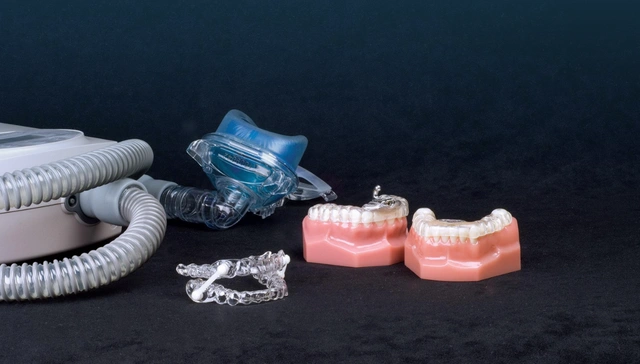
| Mandibular advancement device (MAD) | Adults with mild to moderate OSA | Holds the lower jaw slightly forward during sleep to keep the airway open |
| Surgical orthodontics (MMA) | Adults with severe skeletal discrepancy | Repositions both jaws surgically to significantly improve airway dimensions |
Palatal Expansion in Children: Widen the Upper Jaw, Open the Airway
Rapid palatal expansion (RPE) uses a fixed appliance to gradually widen the upper jaw. As the palate widens, nasal airway volume increases, tongue space improves, and the overall airflow through the nose becomes easier.
This approach is most effective before the midpalatal suture fuses, typically before the mid-teens. The ideal window is generally between ages 7 and 14. Research published in leading orthodontic journals has consistently shown improvement in paediatric sleep apnoea symptoms following palatal expansion, particularly when combined with other interventions such as adenotonsillectomy where needed.
Forward Growth Modification: Repositioning the Lower Jaw
In children whose lower jaw sits too far back, functional appliances like the Twin Block or Herbst device can encourage forward growth during the pubertal growth spurt. This repositions the jaw to open the space behind the tongue, which is exactly where the airway is most likely to collapse during sleep.
Timing matters a great deal here. The earlier these patterns are identified, the more the brace or appliance can work with natural growth rather than against a structure that has already set.
Mandibular Advancement Devices for Adults: Custom Dental Appliances That Work at Night
For adults with mild to moderate sleep apnoea, a mandibular advancement device (MAD) is a well-established option. These are custom dental appliances worn overnight. They work by holding the lower jaw slightly forward, which tightens the soft tissue behind the tongue and helps keep the airway open throughout the night.
MADs are often recommended by sleep physicians and fitted by specialist orthodontists. A 2024 systematic review confirmed that MAD therapy produces clinically meaningful reductions in apnoea-hypopnoea index (AHI) in mild to moderate sleep apnoea patients.
They are also particularly valuable for patients who cannot tolerate CPAP.
At Michael Woods Orthodontics, these dental appliances are fitted as part of a multidisciplinary plan, in coordination with your GP or sleep physician.
Surgical Orthodontics: For Severe Cases
In severe cases of adult OSA involving a significant skeletal jaw discrepancy, maxillomandibular advancement surgery (MMA) may be considered. This is performed by an oral and maxillofacial surgeon, but planned in collaboration with the orthodontist. By moving both jaws forward, the procedure can dramatically improve airway dimensions. This is reserved for cases where CPAP and dental appliances have not been effective or are not suitable.
Children vs Adults: Different Treatment Windows
One of the most important things to understand is that the opportunity for orthodontics to genuinely change airway development is much greater in children than in adults.
In children, the jaw and palate are still growing. That means orthodontic treatment doesn’t just manage the existing structure. It can actually guide growth into a better pattern, with real, lasting benefits for breathing and sleep. In adults, the skeleton is set. Orthodontics can improve alignment and help with dental treatment options like MADs, but it cannot grow new bone without surgery.
This is precisely why early screening matters so much. If an Armadale parent notices mouth breathing, restless sleep, or daytime fatigue in their child, getting a specialist orthodontic assessment before age 10 could make a meaningful difference to that child’s development and long-term sleep health.
A 2024 study published in the American Journal of Orthodontics and Dentofacial Orthopedics specifically addressed the question of how early orthodontic intervention can support airway development in children with OSA risk factors. The growing consensus supports assessment before the teenage years.
When Orthodontics Is Not Enough: Setting Realistic Expectations
Honesty here matters. Orthodontic treatment is rarely a standalone cure for sleep apnoea, and patients and families must understand this before starting any plan.
Untreated sleep apnoea carries real health risks, including elevated risk of heart disease, high blood pressure, poor concentration, and reduced quality of life. For moderate to severe OSA in adults, CPAP remains the gold standard.
The most effective approach brings together a GP, sleep physician, and in many cases an ENT, with the specialist orthodontist contributing the dental and jaw perspective. Orthodontics can improve outcomes significantly when it’s part of that coordinated picture. It works best when it’s not working alone.
Why Armadale Families Choose a Specialist Orthodontist for Airway Concerns
Not all dental professionals are equally placed to manage orthodontic issues with an airway component. Specialist orthodontists complete an additional three years of postgraduate training, focused specifically on jaw development, airway anatomy, growth modification, and orthodontic care across all ages. General dentists have a different and valuable skill set, but this level of airway and growth expertise is specific to specialist training.
Professor Michael Woods brings over 35 years of experience to complex growth and airway cases in Melbourne. The practice at 549 Dandenong Road, Malvern, is approximately 3 km from Armadale and offers Saturday appointments, making it genuinely accessible for busy families across Melbourne’s inner south-east.
No referral is required to book a consultation.
| Specialist Orthodontist | General Dentist |
|---|---|
| Additional 3-year postgraduate qualification in orthodontics | Undergraduate dental degree |
| Trained in jaw development, airway anatomy and growth modification | Not specifically trained in airway orthodontics |
| Experienced in fitting custom mandibular advancement devices | May offer limited orthodontic treatments |
| Can coordinate multidisciplinary care with sleep physicians | Best for general dental health and referral |
Book Your Airway and Orthodontic Assessment Near Armadale
If you’re an Armadale parent with concerns about your child’s breathing or sleep, or an adult who wants to explore whether orthodontics can help alongside your current management plan, we’d love to hear from you.
Professor Michael Woods and the team at Michael Woods Orthodontics take a no-pressure, evidence-based approach to every consultation. No referral is required.
- Phone: (03) 9509 7496
- Address: 549 Dandenong Road, Malvern (approximately 3 km from Armadale)
- Hours: Weekdays and Saturdays available
We see patients from across Melbourne’s inner south-east, including Armadale, Toorak, Prahran, South Yarra and beyond. Early intervention is almost always easier than late correction, so don’t sit on your concerns.
For more information on the appliances used in orthodontic airway treatment, visit our orthodontic appliances page. You might also find it helpful to read our guide on why choosing a specialist orthodontist in Armadale matters and our article on early interceptive orthodontics for children aged 7 to 10.
Frequently Asked Questions
Can a child grow out of sleep apnoea on their own?
Sometimes, but not reliably. If the cause is jaw and airway structure, early orthodontic treatment tends to produce far better outcomes than waiting and hoping the problem resolves itself.
Do I need a sleep study before seeing an orthodontist?
Not necessarily. A sleep study is needed to formally diagnose OSA, but an orthodontic assessment can happen at any time. If obstructive sleep apnoea is suspected during your consultation, an appropriate referral will be arranged.
Are braces better than Invisalign for airway concerns?
Neither is primarily an airway treatment. For sleep apnoea and snoring with a structural cause, appliances like palatal expanders or mandibular advancement devices are far more relevant than braces or aligners.
Will orthodontic treatment replace my CPAP?
Not always. For mild to moderate sleep apnoea, a custom MAD may reduce or occasionally eliminate the need for CPAP. For more severe cases, CPAP remains the gold standard, and orthodontic solutions are best used alongside it.
How do I know if my child's snoring needs attention?
Snoring regularly, mouth breathing, waking tired, or unexplained behavioural changes are all reasons to seek a specialist orthodontic care assessment. The earlier the review, the more treatment options are available to improve sleep apnoea symptoms and support healthy development.
Leave a Reply