

Can Adults Widen Their Upper Jaw Without Surgery?
Can Adults Widen Their Upper Jaw Without Surgery?
Being told that your upper jaw is narrow can raise two immediate questions: can it still be widened in adulthood, and does that automatically mean surgery? The honest answer is that adults do have expansion options, but the right one depends on the shape and maturity of the upper jaw, the amount of widening required, the gums and supporting bone, and the rest of the bite.
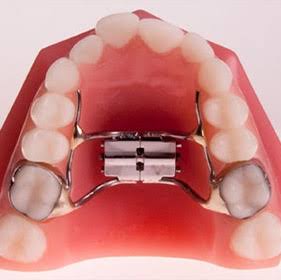
One option is MARPE, short for miniscrew-assisted rapid palatal expansion. It uses a fixed appliance connected to small temporary anchorage screws in the palate. Those screws direct more of the expansion force towards the upper jaw rather than relying only on the teeth. MARPE can provide a non-surgical route for some adults, but it is not suitable or successful in every case. The practice’s orthodontic appliance guide explains how appliances fit into a wider treatment plan.
What does a narrow upper jaw mean?
The upper jaw, or maxilla, can be too narrow relative to the lower jaw. This is called a transverse discrepancy. It may show up as a crossbite, crowding, a high narrow palate or a bite that shifts to one side when the teeth close.
Crowded teeth do not prove that the jaw is narrow. Crowding can have several causes, and widening the jaw is not a routine answer for every adult who wants more space. A specialist orthodontic assessment separates tooth-position problems from a true skeletal width problem.
Why is expansion different in an adult?
In a growing child, a conventional expander can often work through the teeth and the developing joint down the centre of the palate. As growth finishes, that mid-palatal suture becomes more interlocked and resistant.
Age helps frame the question, but a birthday does not reveal exactly how a person’s suture will respond. Skeletal maturity, anatomy and appliance design all matter. That is why an online age limit cannot decide whether an adult is suitable for expansion.
How does MARPE work?
A MARPE appliance usually sits across the roof of the mouth. Orthodontic bands or other connections help stabilise it, while miniscrews provide anchorage in the palate. The expansion screw is activated according to a schedule set for the individual patient.
The aim is to create skeletal widening while limiting unwanted tipping of the supporting teeth. A small space may appear between the upper front teeth during active expansion. That can be an expected sign, but it should be interpreted by the treating orthodontist rather than used as a do-it-yourself measure of success.
Who may be considered for MARPE?
MARPE may be considered when an older adolescent or adult has a confirmed narrow upper jaw and conventional tooth-borne expansion is unlikely to provide the required skeletal change. The amount and pattern of constriction, bone available for anchorage, periodontal health and the wider treatment plan are important.
It may not be appropriate where the anatomy cannot support safe placement, oral hygiene or gum health is unsuitable, the required change is beyond what the appliance can reasonably provide, or another surgical or orthodontic plan would address the problem more predictably.
Does MARPE always avoid surgery?
No. MARPE creates a non-surgical possibility for selected patients; it does not make surgically assisted expansion obsolete. Some palatal sutures do not open as intended, and some jaw relationships need surgical management for reasons that an expander alone cannot address.
A careful consultation should explain both routes without presenting surgery as a failure. Professor Michael Woods spent 28 years as consultant orthodontist to the oral and maxillofacial surgery unit at the Royal Melbourne Hospital. That background is relevant when an adult needs the boundary between orthodontic and surgical options assessed clearly.
What does the evidence say?
Research in late adolescents and adults reports that MARPE can produce skeletal and dental expansion, but the quality of the evidence has important limits. Many studies are observational, use different appliances and protocols, and have limited long-term follow-up.
Reviews of MARPE research have reported variable outcomes and limitations in the available evidence. In plain language: MARPE is a real treatment option, but published averages cannot predict one person’s outcome.
What happens at an assessment?
The orthodontist listens to the concern, examines how the upper and lower teeth meet, and looks at the shape of the arches and gums. Photographs, digital scans and appropriate radiographic imaging may be needed. Imaging should be justified by the information required; it is not taken merely because a technology is available.
The plan also needs to account for what happens after widening. Expansion may create space, but teeth often still need braces or clear aligners, and the new width needs a retention or consolidation phase. That sequence can be discussed during an adult orthodontics assessment.
What are the main risks and limitations?
Possible issues include pressure and tenderness, irritation around the appliance, difficulty cleaning, miniscrew loosening, unwanted tooth movement, gum or supporting-bone changes, asymmetric expansion and failure of the suture to open. Individual risk depends on anatomy and technique.
Patients should receive instructions about activation, cleaning and what deserves a phone call. Continuing to turn an appliance when something looks or feels wrong can make a manageable issue harder to assess.
Questions to take to your consultation
Bring these questions so the appointment covers the diagnosis, alternatives and the full treatment sequence:
- What is the underlying tooth or jaw problem?
- Which part of the proposed treatment addresses it?
- What reasonable alternatives apply to my case?
- What are the material risks and practical limitations?
- What happens if the expected response does not occur?
- Which other dental or medical practitioners need to be involved?
- What is included in the written fee and what could be separate?
- What retention or follow-up will be needed afterwards?
Take time to understand the answers. Orthodontic treatment is planned over months or years, so a low-pressure decision based on complete information is more useful than choosing quickly from a headline.
Related information from the practice
Adults who need tooth alignment as well as expansion can review the practice’s adult treatment options. See adult orthodontics.
The appliance overview explains how fixed and removable devices serve different parts of a plan. See orthodontic appliances.
The appointment page explains consultation, records and treatment planning. See appointment process.
The practitioner page lists both specialist orthodontists’ qualifications and clinical backgrounds. See Professor Michael Woods and Dr Nevenka Tadic.
Book an initial consultation
Michael Woods Orthodontics is a specialist orthodontic practice on Dandenong Road, on the Malvern/Armadale border. Professor Michael Woods and Dr Nevenka Tadic both hold specialist registration in orthodontics. At an initial consultation, the team can discuss your concern, whether treatment is appropriate and which options reasonably apply.
Call (03) 9509 7496 or use the contact form to request an initial consultation.
Frequently asked questions
Can an adult palate really be expanded?
Yes, selected adults can undergo maxillary expansion. The appropriate method may be MARPE, surgically assisted expansion or another plan, depending on the diagnosis.
What age is too old for MARPE?
There is no reliable universal cut-off. Response varies with skeletal maturity and anatomy, so suitability must be assessed rather than decided by age alone.
Is MARPE the same as a normal palate expander?
No. Conventional expanders usually rely more on teeth and are commonly used while a patient is growing. MARPE adds temporary skeletal anchorage in the palate.
Does MARPE hurt?
It can involve pressure, tenderness and irritation, especially during early activation. Experience varies, and severe or worsening pain should be reported.
Will a gap appear between my front teeth?
A temporary central gap can develop when the suture opens. Its presence, absence and management should be reviewed by the orthodontist.
How long does adult palate expansion take?
Active expansion and the later consolidation period vary with the appliance, response and treatment plan. A personalised timeframe comes after records and assessment.
Will I still need braces or aligners?
Often, yes. Expansion changes width; further orthodontic treatment may be required to position teeth and coordinate the bite.
Do I need a referral?
A patient can contact a private specialist orthodontic practice directly, although general dentists commonly refer when they identify a bite or jaw-width concern.
Leave a Reply