

Class III Open Bite Treatment Near Armadale: What to Expect and Why Timing Matters
Some kids struggle to bite through a soft bread roll, not because they’re being fussy, but because their front teeth never actually meet. That’s Class III open bite, and plenty of Armadale families notice it without ever knowing there’s a name for it, or what can happen if it’s left alone.
It’s more common than people realise. Research published in the Journal of Dental & Oral Disorders (2024) confirms that Class III malocclusion affects a meaningful portion of the population globally: and a Charles Sturt University study of Australian school children found that anterior open bite affected around 24% of children aged 7 to 12 in the study group.
Without the right specialist care, this kind of dental open bite can lead to long-term oral health issues that become much harder: and more involved: to treat in adulthood. The good news? When it’s caught early, there’s a lot that can be done.
What Is a Class III Open Bite Malocclusion?
Open bite is a type of malocclusion where the upper and lower teeth don’t make contact when the mouth is closed. In a typical bite, the front teeth slightly overlap. With an open bite, there’s a visible gap: often right at the front of the mouth.
Class III refers to the position of the jaws. In a Class III jaw relationship (sometimes called an underbite), the lower jaw sits further forward than the upper jaw. When you combine this with an open bite, you’ve got both a jaw alignment issue and a bite problem happening at the same time: and that combination creates real functional challenges.
The two main types are:
- Anterior open bite: the most common, where the front teeth don’t meet even when the back teeth are closed together
- Posterior open bite: less common, where the back teeth don’t make contact on one or both sides
Open bite malocclusion can affect children and adults, though how it’s treated depends a lot on the patient’s age and whether the jaw is still growing.
What Causes Class III Open Bite?
There’s rarely one single reason. Most cases come down to a combination of genetics and habits. Some of the most common contributing factors include:
- Genetics: A strong lower jaw growth pattern often runs in families. If mum, dad or grandparents had a prominent lower jaw, there’s a good chance the kids might too
- Thumb sucking or finger sucking: prolonged thumb sucking or use of a dummy or pacifier can push the front teeth outward and interfere with normal jaw development
- Tongue Thrusting: When the tongue pushes forward against the front teeth during swallowing or at rest, it can prevent the upper and lower front teeth from meeting properly. Tongue thrusting is a surprisingly common habit and often goes unnoticed by parents
- Skeletal jaw discrepancy: sometimes the upper jaw and lower jaw simply grow at different rates, creating a mismatch in size or position
Understanding the cause matters because it directly shapes the treatment plan. A habit-driven open bite in a young child is approached very differently from a skeletal Class III malocclusion in a teenager.
How Does It Affect Daily Life?
This isn’t just an aesthetic concern. A Class III open bite affects how someone chews, speaks, breathes and feels about their smile. Here’s what Armadale families commonly notice:
- Chewing difficulty: because only the back teeth make contact, chewing is less efficient and can feel awkward or tiring
- Speech issues: the gap between the upper and lower teeth makes it harder to form certain sounds, particularly ‘s’ and ‘f’. Lisping is very common
- Jaw pain or discomfort: the temporomandibular joint can come under strain when the jaw isn’t in the correct position, leading to jaw pain and tension headaches
- Facial appearance: a prominent lower jaw and lips that look strained at rest are typical signs. Kids can become self-conscious about this, especially as they get older
- Breathing patterns: an open bite can be associated with mouth breathing, which, over time, affects facial growth and long-term oral health
These aren’t minor inconveniences. Left untreated, they can compound and affect a child’s confidence, eating habits and oral health well into adulthood.
Why Timing of Treatment Is Critical
This is probably the most important thing to understand, so it’s worth saying plainly: the earlier a Class III open bite is identified, the more treatment options are available, and the less invasive those options tend to be.
Between roughly ages 9 and 14, children are still in a growth window where the jaws are actively developing. A specialist orthodontist can use this window to guide jaw growth and correct the bite without surgery. Miss that window, and in adults with a fully developed skeleton, surgical orthodontics may be the only way to achieve a proper result.
The American Association of Orthodontists recommends a first orthodontic assessment by age 7, and Australian specialist orthodontists echo this guidance. At 7 years old, there’s usually enough adult teeth in place to identify developing problems: while the jaw is still growing and most responsive to early intervention.
Treatment Approaches Used by Specialist Orthodontists
Interceptive Orthodontics for Children (Kids Removable Plates & Functional Appliances)
For younger children who are still growing, interceptive orthodontics is the first line of treatment. This might involve:
- Functional appliances: removable or fixed devices that encourage the upper jaw to grow forward and redirect the lower jaw. Think of it as guiding the jaws into a healthier relationship while growth is still happening
- Kids’ removable plates: custom-made plates that can help widen the upper jaw or correct the bite gradually
- Palatal expanders: used when the upper jaw is too narrow and needs widening to create proper alignment
Professor Michael Woods has extensive experience in paediatric orthodontics and has been applying these techniques for over 35 years. Early intervention at this stage can significantly reduce, or in some cases eliminate, the need for surgery later.
Braces in Adolescence (Metal Braces & Traditional Braces)
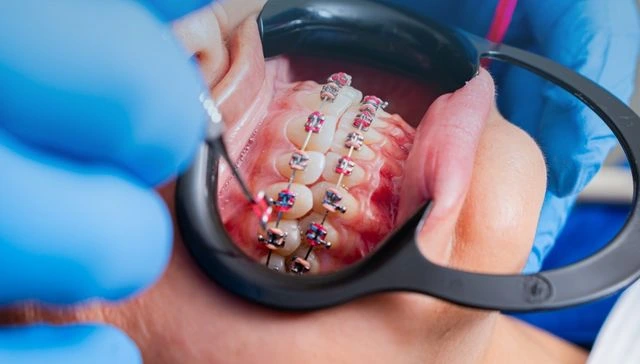
Once the growth phase has been managed, full braces are often used to fine-tune the position of individual teeth and achieve a healthy bite. Both metal braces and traditional braces work well for this stage: they give the orthodontist precise control over tooth movement.
Treatment with braces in adolescence is generally more straightforward when interceptive treatment has already been completed, because the major jaw correction has been done. Braces at this point are about refining the result.
Surgical Orthodontics for Adults (Orthognathic Surgery)
For adults whose jaws have finished growing and where there is a significant skeletal discrepancy, the best outcome is usually achieved through a combination of orthodontic treatment and orthognathic (jaw) surgery. This is called surgical orthodontics.
Surgery is used to reposition the jaw into the correct position, and braces are used before and after to align the teeth. The results are generally very stable and can be genuinely life-changing for patients who’ve been living with a severe open bite for years. Scarring is typically internal: the incisions are made inside the mouth, so visible scarring is rarely a concern.
Is Invisalign an Option for Class III Open Bite?
This is a question we get a lot. The short answer: it depends on the severity.
Invisalign and clear aligners can manage mild cases of open bite, and they work well as part of a combined treatment approach in some patients. However, a complex Class III open bite: particularly one with a significant skeletal component: typically requires fixed appliances like braces or clear aligners used in combination with other appliances, not Invisalign alone.
Braces or clear aligner systems may be recommended together for the best functional result. Only a thorough specialist assessment can determine what’s right for each individual patient. There’s no one-size-fits-all answer here, which is exactly why seeing a specialist matters.
Why Armadale Families Choose Michael Woods Orthodontics
Michael Woods Orthodontics is located in Malvern, just a short drive from Armadale: and has been a trusted name in complex bite correction and orthodontic treatment Melbourne families rely on for over 35 years.
Here’s what sets the practice apart:
- Professor Michael Woods is internationally recognised in the field of orthodontics, with a particular focus on complex jaw and bite problems. His level of experience with Class III malocclusion and open bite cases is not something you’ll find everywhere
- Dr Tadic brings specialist expertise in comprehensive orthodontic care, ensuring patients receive a thorough and personalised treatment melbourne approach from start to finish
- A genuinely patient-centred approach: the team takes the time to explain everything clearly, so families know exactly what to expect at every stage. Treatment and at the conclusion of care, patients consistently report feeling informed and supported throughout
- Flexible payment options: the practice offers payment plans to all patients, with deposit and interest-free options available, making treatment accessible. Interest free payment plan arrangements mean families can get started without financial stress
- Convenient Saturday appointments: available every second Saturday from 12pm to 4pm, which is a real bonus for busy Armadale families who can’t always make it during the week
- Melbourne free consultation / free initial consultation: new patients can book a free initial consultation to get a clear picture of what treatment options are available before committing to anything
Whether your child is 7 years old and you’ve just noticed something seems off, or you’re an adult who’s been putting off treatment for years, the team at Michael Woods Orthodontics is equipped to help: from simple dental malocclusion concerns through to complex surgical cases.
Book your consultation here → or call the Malvern practice directly. Saturday appointments are available every second week.
Frequently Asked Questions
Can a Class III open bite self-correct in children?
Sometimes, if it's habit-related (thumb sucking, dummy use), the habit stops early enough. But a skeletal Class III open bite won't fix itself. Get it checked rather than waiting to see.
At what age is it best to start treatment?
Around 7 years old is ideal for a first assessment, with active treatment often starting between 9 and 12. That said, adults can still get great results: it's never too late.
Does surgical orthodontic treatment always leave visible scars?
Rarely. Most orthognathic surgery is done from inside the mouth, so there's nothing visible on the outside.
What's the difference between an underbite and a Class III open bite?
An underbite means the lower teeth sit in front of the upper teeth. An open bite means the front teeth don't meet vertically. A Class III open bite is happening at once, which is why it needs specialist care.
Will my child definitely need surgery if we don't treat now?
Not guaranteed, but the risk goes up significantly. Treating during the growth years gives the orthodontist tools that simply aren't available once the jaw has finished developing.
Leave a Reply