

Living with a Deep Overbite (Class II Division 2 Malocclusion): Real Impacts on Your Daily Life and How Armadale Orthodontists Can Help
Does your jaw ache after a big meal? Have you noticed your lower front teeth chipping or wearing down faster than they should? Maybe biting into a burger or a crusty bread roll feels more awkward than it should be.
If any of this sounds familiar, you might be living with a Class II Division 2 malocclusion: a specific type of deep bite that does far more than affect how your smile looks. It shapes the way you eat, speak, and feel every single day. This article is for anyone who’s wondering: “How does this actually affect me, and what can I do about it?”
We’ll walk you through the real-life experience of this condition and how specialist orthodontic treatment can help.
What Is Class II Division 2 Malocclusion?
Without going into too much detail here, we cover the clinical side in depth on our Class II Division 2 treatment page: the key thing to know is this: Class II Division 2 is a type of Class II malocclusion where the upper front teeth are tipped inward (retroclined) rather than flared out, and the upper teeth overlap the lower teeth deeply. This malocclusion with a deep overbite creates a very distinct bite pattern that, when left untreated, causes a ripple effect across your whole oral health.
How a Deep Overbite Affects Eating: More Than You'd Think
This is one of the most common things patients raise at their first consultation, and it’s completely valid. When you have a class II division 2 malocclusion, the upper and lower teeth don’t meet efficiently. The overbite is so pronounced that your bite alignment is off, making it genuinely harder to bite into certain foods.
Think about:
- Apples, pears, and firm fruits: that front-tooth bite just doesn’t connect properly
- Crusty bread, baguettes, or a sandwich with thick fillings: frustrating and awkward
- Burgers, wraps, and anything you need to bite through cleanly: the bite depends on proper upper and lower tooth contact, which is compromised here
What’s interesting is that a lot of patients don’t even realise they’ve been unconsciously avoiding certain foods for years. They’ve just adapted. Over time, that kind of compensation puts uneven stress on the posterior teeth and jaw muscles, and that’s where things start to snowball. An adult patient who hasn’t had this addressed can find that what started as a mild inconvenience gradually becomes a more significant issue.
Speech and Social Confidence
The connection between dental alignment and speech isn’t always obvious, but it’s real. A deep bite malocclusion can subtly affect how certain sounds are formed, particularly sounds that rely on the tongue making contact with the upper front teeth, like “th,” “s,” and “z” sounds.
For some people, it’s not so much about the speech sounds themselves: it’s about how their smile looks at rest. When the upper front teeth are tipped inward, and the deep bite is severe, it can affect how the lips sit, how much tooth is visible, and overall facial profile and soft tissue appearance. That can knock confidence, especially in social or professional situations.
This is a sensitive area, and we want to acknowledge it honestly. The way your teeth look and function is deeply personal. You deserve to feel comfortable in your own face, and orthodontic treatment can genuinely change that.
Jaw Fatigue and TMJ Problems: The Hidden Toll of an Untreated Class II Malocclusion
This is where things get serious, particularly for adults who’ve been living with this condition for a long time.
When your bite isn’t balanced, your temporomandibular joint (TMJ): the hinge joint connecting your lower jaw to your skull, is forced to compensate. Over months and years, that compensation leads to real problems. The temporomandibular joint is not designed to carry that kind of uneven load indefinitely.
Common signs and symptoms include:
- Morning jaw aches: waking up with a sore, tight jaw
- Clicking or popping sounds when opening or closing your mouth
- Tension headaches, especially around the temples
- Neck and shoulder stiffness related to jaw muscle tension
- Limited mouth opening in more advanced cases
Research published in BMC Oral Health found that in Australia, TMD is experienced by almost 10% of Australian adults BioMed Central, with signs appearing in up to 60–70% of the general population according to the Royal Australian College of General Practitioners RACGP. Not all of these cases are caused by class II malocclusion, but an untreated class II division bite problem is a well-recognised contributor to jaw joint dysfunction. Among adults in the Armadale and surrounding areas who present to orthodontists in their 30s, 40s, and 50s, this history of long-standing jaw discomfort is extremely common.
The good news: addressing the underlying malocclusion through proper orthodontic treatment often brings significant relief to these symptoms, sometimes for the first time in years.
.
Wear and Tear on Your Teeth
This is a direct, mechanical consequence of a class II division 2 malocclusion, and one that gets worse without treatment.
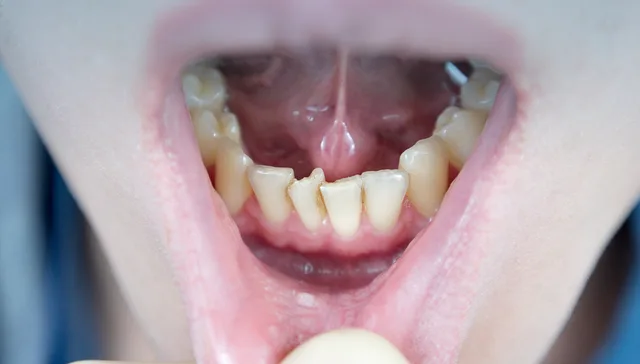
When the overbite is this deep, the lower front teeth (mandibular incisors) don’t have a normal resting position. Instead, they bite up into the palate or make contact with the backs of the upper teeth in a way they were never meant to. The mandibular incisor takes a disproportionate load with every bite and every chew.
Over time, this causes:
- Accelerated tooth wear: lower front teeth can become noticeably shorter
- Chipping: the enamel on the lower front teeth becomes thin and fragile
- Sensitivity: worn tooth enamel exposes the inner dentine, leading to temperature sensitivity
- Trauma to the palate: In some cases, the lower teeth bite directly into the gum tissue behind the upper teeth, causing soreness
According to a 2024 systematic review published in BDJ Open, the most prevalent site of wear in Class II Division 2 patients was found on the lower incisors, followed by the upper incisors and posterior teeth. The excessive curve of the spee that characterises this condition also concentrates biting forces in ways that are hard on the anterior teeth long term.
These are dental changes that, without treatment, tend to become increasingly difficult and costly to manage over time.
The Good News: Treatment Works: at Any Age
Let’s be clear about something: Class II malocclusion with deep overbite is very treatable. The effectiveness of orthodontic treatment for this condition is well-supported, and the treatment results can be life-changing: not just cosmetically, but functionally.
The primary goals of orthodontic treatment for this type of bite include:
- Correcting the overbite and achieving a balanced bite
- Improving the position and alignment of the upper and lower teeth
- Relieving the stress on the temporomandibular joint
- Preventing further tooth wear and damage
- Restoring proper bite alignment and function
At Michael Woods Orthodontics, the team has extensive experience in the management of Class II division bite problems in adults. The treatment approach is always individualised: there’s no one-size-fits-all here. Depending on the severity and the patient’s goals, treatment options may include:
- Fixed braces (traditional or ceramic)
- Clear aligners (such as Invisalign)
- Functional appliances in younger patients to guide jaw development
- In complex skeletal cases, a referral for orthognathic surgery (jaw surgery) may be discussed, though this is not required for most adult patients
- In some cases, premolar extraction may be considered as part of the treatment plan
- Treatment was performed without extractions and using appliances alone in many adult patients: something that has become increasingly achievable with modern orthodontics
The treatment of class II division cases, including the long-term evaluation of treated class ii division 2 patients, shows strong outcomes when managed by a specialist. The treatment of a class II malocclusion with deep overbite benefits enormously from having clear treatment objectives and treatment plans tailored to the individual’s specific dental and skeletal presentation.
The team at Michael Woods Orthodontics has treated similar adult orthodontic patients from across the Armadale, Toorak, Malvern, and Glen Iris areas, and results speak for themselves.
What to Expect at Your First Consultation in Malvern
The first appointment is about information: not commitment. It’s a chance for the orthodontist to understand your bite, your concerns, and what’s actually going on clinically.
At Michael Woods Orthodontics, located in Malvern, about 3 km from Armadale, your initial consultation will typically include:
- Photographs of your face and teeth
- Digital x-rays, including a cephalometric (side profile x-ray) to assess the skeletal relationship of your jaws
- Digital intraoral scans: no uncomfortable moulds required
- A thorough oral health review
- A discussion of your symptoms, history, and appropriate treatment options
There’s no pressure. No obligation. Just a clear, honest conversation about what’s happening with your bite and what can be done about it. The team at Michael Woods Orthodontics prides itself on a friendly, low-pressure environment where patients feel heard.
Whether you’re coming in with years of jaw pain, chipped teeth, or just a feeling that something’s never quite been right with your bite, this is the right place to start.
Ready to Find Out More?
We welcome patients from Armadale, Toorak, Glen Iris, Malvern, and the surrounding areas. If you think you might have a deep bite or class ii division 2 malocclusion, don’t wait for it to get worse. The earlier you address it, the more treatment options are available to you.
Learn more about treatment for Class II Division 2:
Michael Woods Orthodontics 📍 Malvern (approx. 3 km from Armadale) 📞 (03) 9509 7496
Frequently Asked Questions
Can a deep overbite (Class II Division 2) cause jaw pain?
Yes, and it's one of the most common reasons adults finally seek help. When the bite is off, the jaw joint (TMJ) compensates, leading to soreness, clicking, and headaches over time. Untreated class ii division 2 malocclusion is a well-known contributing factor to TMJ dysfunction.
I'm an adult in my 40s: is it too late for orthodontic treatment?
Not at all. Teeth move at any age, and adults in their 30s, 40s, and 50s are treated successfully at Michael Woods Orthodontics all the time. It's never too late to correct a deep bite.
Will my teeth keep wearing down if I don't treat them?
Yes. The lower front teeth bear unnatural bite force in a class II division 2 bite, leading to progressive chipping, wear, and sensitivity. The longer it's left, the more dental damage accumulates.
What's the difference between Class II Division 1 and Class II Division 2?
In class II division 1, the upper front teeth flare forward with a noticeable overjet. In division 2, they tip inward, and the bite is very deep vertically. Both are types of class II malocclusion, but require different treatment approaches.
Does orthodontic treatment for a deep bite always involve extractions?
Not always. Many patients are treated without extractions using braces or aligners alone. Whether premolar extraction is needed depends on your specific bite, crowding, and treatment objectives: something your orthodontist will discuss clearly at your first consultation.
Leave a Reply